Writing, like sculpture

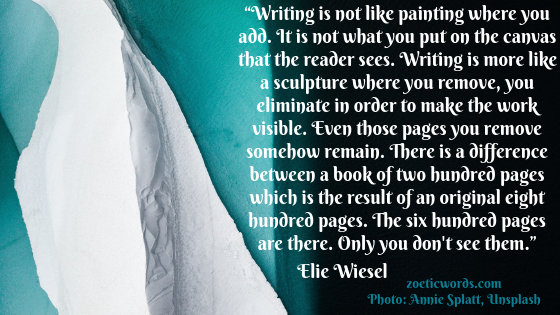
Don’t be afraid to overwrite your drafts. Revision and editing will sculpt the story into a publishable form. The better you understand your characters and their story, the better your book will be. Know that backstory but feed it sparingly through the story. Understand what happened to make your characters the people they are when your story starts. Know why their mother and father fought and why their grandparents died.

Just as the iceberg you see is merely the tip of a very large underwater berg, the published book is often just like it. The reader has only the book before her, yet it will be obvious that you know it all. Those 800 invisible pages are there.

First get it written

The best advice. Writing your ‘dirty’ first draft is merely the first stage of getting a book out. It’s all about getting to know your story and what it’s all about.

Once the story is down on the page, it’s time to let it sit for a while, get some objectivity and distance before diving back in.

Then, and only then, is it time to ‘get it right’, make sure the story is all there, that there’s nothing missing, layering in anything missing, and editing out extraneous details and unnecessary words.

None of this can be done before you get the story out of your head and written.

A classic book

Don’t you love a book that you can still discuss years after you first read it?

A classic can be one which gave you a new way of seeing an issue, an aspect of life, love or happiness. It may have changed your life forever.

A book you can read over and over again without ever getting bored.

A book you can argue about for years, each with your own interpretation, opinion and viewpoint over meaning, the best alternative ending, why a character acted a certain way and so on.

A book you can recommend to everyone you meet and which can mean as much to them for either the same or another reason as yours.

A great story

Life is outrageous. Life is unbelievable. Life is drudgery. Life can be all of those things and more.
Story is the outrageous and unbelievable without the drudgery, without the breakfast cereal, the ‘hello, how are you this morning,’ and ‘how does your garden grow?’ unless, of course, the cereal is laced with arsenic, the hello is from a serial killer or the garden hides a body. In other words, unless they are vital to the telling of your story.
Keep your story moving. Match the pace to the story. Don’t slow it with unnecessary words, beautiful though they may be, if they don’t progress the story, they don’t belong in it.

Strip every sentence

A great writer is that way by intention. Each word is carefully selected to create just the right mood and atmosphere. Clarity and ambiguity are never left to chance but are by deliberate choice.

Weed out the unnecessary, the showy, the waffling and the cutesy words and phrases which cloud the issue skies and leave only the best.

Make every word earn its place in your manuscript, preferably with more than one reason for its particular use over another, more general, less specific word. The choice of sound, sense and sensitivity are chosen with the reader in mind rather than the writer. Less show, more beauty.