There is a time for showing and a time for telling in writing. This is the best explanation for the effect on the reader of each of these methods of conveying information to your reader.
Consider what effect you wish to create in your reader when making the decision whether you ought to show or tell.
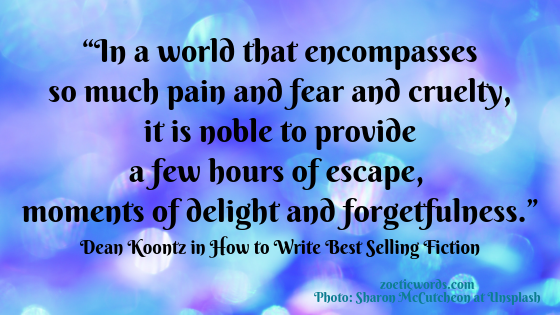
Had you thought of writing, as a noble occupation? I know that when I read I find that escape, those moments of delight and forgetfulness. I appreciate the plotting, planning, writing, rewriting, editing and all the other hours of work that go into publishing a book. So thanks to all the hardworking, underpaid writers and authors out there for your nobility.
How can we as readers show our appreciation for the hard work of our favourite authors?
Purchase books through proper channels rather than from dodgy sites. Ensure your favourite authors are paid for their hard work.
Spread the word when you enjoy a book by any means you can. Talk about it. Word of mouth goes a long way toward increasing sales.
Buy books as gifts for people who might enjoy them.
If nothing else, give your favourite books five stars or write a book review where you purchase them, on Goodreads, your blog…
Share your delight on your favourite social media platforms; Facebook, Twitter, Instagram, Pinterest…
Teach your children the joy of reading and an appreciation for this nobility.
Issues are rarely black and white. It’s been said that there are always at least two or three versions of any incident: your version, my version, and the truth. Yes, maybe that’s not always the case but it illustrates the fact that we don’t always look at issues from all sides.
One of my alltime favourite books about an important issue is Richard North Patterson’s “Balance of Power” which explores the US gun control issue from just about every side of the issue: the shooters, the family of the victim, the sellers, the buyers, the politicians…
Understanding our fellow humans and their viewpoints is important, whether we agree with them or not. There, in the gray area, is where we often find our best story.
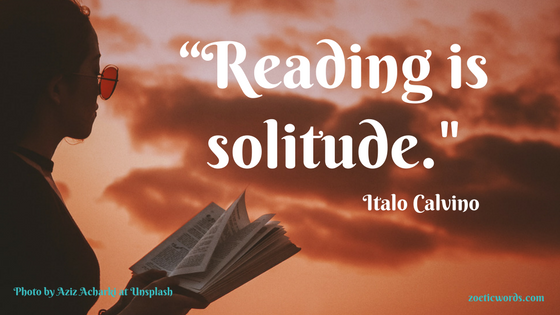
How do you find solitude in the middle of a crowd? On a train, on a bus, at an event that has lost your interest? Take out your favourite book!
I recently listened to “Romeo and Juliet: A Novel” by David Hewson, narrated or performed by Richard Armitage. In an interview about the book, they spoke about the German expression Kopfkino, literally “cinema in the head.” What a fitting way of expressing what happens when one reads, or listens to a reading or performance of a book.
Nobody but you knows what goes on in your head. Even if you wanted to, even though you can try to express it, it’s rare that you could actually do so. There, in your head, you are alone with your thoughts and the images you see.
Almost as good as writing, seeing a new story for the first time, immersing oneself into a new world, literally making it up as you go. Populating your new world with your own characters.
Don’t you love a book that you can still discuss years after you first read it?
A classic can be one which gave you a new way of seeing an issue, an aspect of life, love or happiness. It may have changed your life forever.
A book you can read over and over again without ever getting bored.
A book you can argue about for years, each with your own interpretation, opinion and viewpoint over meaning, the best alternative ending, why a character acted a certain way and so on.
A book you can recommend to everyone you meet and which can mean as much to them for either the same or another reason as yours.




 Zoetic Words